Hiển thị các bài đăng có nhãn Vietnam travel guide. Hiển thị tất cả bài đăng

Thứ Ba, 8 tháng 12, 2015

Best time to visit Vietnam

Spring (February to April) and Autumn (August to October) is the most beautiful seasons inVietnam. This is the best time to visit Vietnam as rainfall is lighter and the temperature is more moderate. In March and April, all destinations have the lowest rainfall and temperatures are pleasant. Yet, in the far north it is still cool.

Vietnam Map to show Best time to visit Vietnam

best-time-to-visit-vietnam

best-time-to-visit-vietnam
Being a mountainous town, Sapa has its climate very seasonal with temperatures reaching 29 degrees celsius in summer down to freezing in winter. The climate is the wettest in July and August. Summers are humid season and the average humidity ranges from 75% to 90%. If you are the summer kind of person, the best time to visit Sapa is in March and April, when the weather is warm and dry. Alternatively, you can go in October and November to enjoy cooler climate and clear days.
best-time-to-visit-vietnam
Summers cover months from May to September in Hanoi with heat waves and mild humidity. The average temperature is 32 degrees celsius and you may expect couples of refreshingly short bouts of heavy rain, which often come in the afternoon, throughout the season. The average temperature of winter is 17 degrees celsius accompanied by clouds and drizzle. October and November are the recommended months to visit the capital city as Hanoi is the most beautiful in falls. Days are not too hot with temperature averaging 21 degrees celsius and it is not too rainy, plus extra sunshine.
best time to visit vietnam
Mist, which often covers Halong Bay, may reduce visibility but does add to the atmosphere. You will find the beautiful blue skies and pleasant temperature of Halong from March to May. Summers arrive in May and is to stay until November. They bring warmth, humidity and refreshing afternoon showers. Weather turns quite cold when winter kicks in in December and last until February. You will have the best chance of warm days and clear skies to have perfect cruise in spring or autumn.
best time to visit vietnam
Possessing extensive coastline, Vietnam have a variety of stunning beaches scattering across the country for you to choose from. This means you can visit beaches in Vietnam anytime you please throughout the year as each beach has different best time to visit.
In the height of summer, July and August, the central shores around Danang and Hoi An has the temperature peaking at 38 degree celsius. Technically, the weather is warm year-round, but if you like it hot, go towards the end of the dry season, lasting from February until July. Milder temperature is popular at the beginning of the season. Rainfall increase leading to the rise in water level from August to November. During this season, occasional typhoons should be expected.
top-beaches-highly-appreciated-by-foreign-tourists-in-vietnam
Warm temperatures dominate southern beaches year-round with highs around 30 degree celsius. Months from September to January bring effects of monsoon season to Nha Trang. They can be typhoons occasionally hitting and causing long drizzly days and torrential rain. From June to September, Mui Ne and Phu Quoc see wet season, and while Mui Ne has a microclimate with less rain, it does have some light afternoon showers. Con Dao is humid and hot year-round and experience wet bouts from May to November. Afternoon showers are brief most of time, but night heavy rain will kick in during months from July to September.
best time to visit vietnam
Brief and heavy rains which can cause flooding often visit the old citadel from October to November. From September to December, Hue has a wet season. Hue goes through dry season from January to August, yet still enjoys afternoon showers quite often. In the middle of summer, the average temperature may rise to the mid-thirties.
best time to visit vietnam
Located in the mountains of central Vietnam, Dalat has comfortable temperature year-round, only varying few degrees month to month with temperatures bottoming around 16 degrees and maximizing at roughly 24 degrees. The rainfall is heavier, coming in May to November and bringing the green season when the surrounding countryside is bursting with colour.
best time to visit vietnam
Ho Chi Minh city sticks to consistently warm temperature year-round as it’s much close to the equator. The tropical climate is marked by dry and wet season with balmy day averaging around 28 degrees. Expect tropical downpours in the afternoon from May to November. The rain will not affect travel much and everything is green and lush at this time.
Vietnam’s territory cover a length of over 1,000km and the country has huge regional diversity. As a result, if you intend to see the whole country, it can be complicated to decide on the best time to visit Vietnam. However, it is like a year-round destination, so you can travel to any part of Vietnam during any season is possible. This is your guide on what to expect, where and when.
soure: hivietnam.vn

Thứ Ba, 10 tháng 11, 2015

Mui Ne, Vietnam Tours, Vietnam Holidays

Golden Holiday Travel : Stretching 192km along the coast, the southern province of Binh Thuan boasts great potential for tourism development, especially sea tourism - the most popular destination in Vietnam and perfect beach to end your Vietnam Tours, Vietnam Holidays before coming home.

>> Others topics: Top places to visit in vietnam


Mui Ne - Vietnam tours, Vietnam Holidays
“Paradise” of health resorts

On October 24, 1995, a total solar eclipse occurred in Phan Thiet city of Binh Thuan province, attracting hundreds of thousands of domestic and international scientists and visitors. Since that day, the name Binh Thuan has become well established on the tourism map of Vietnam and the world, and October 24 has become the Province’s Tourism Day.
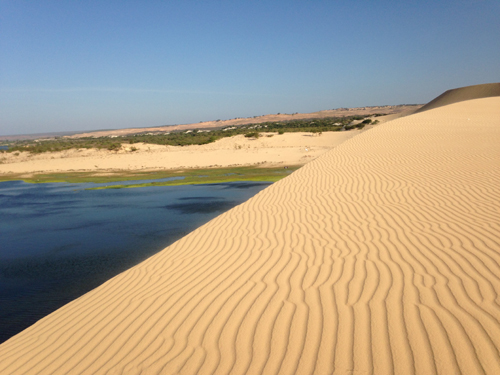
Regarding Binh Thuan’s tourism sector, it is impossible not to mention Mui Ne – Phan Thiet which is considered a paradise for health resorts. The image of Mui Ne with white sand dunes stretching out in the bright tropical sunshine, waves crashing into the calm fishing village, rows of coconut trees and stone steps, has long been familiar to visitors.

Mui Ne is also endowed with sand dunes, a magnificent landscape which has become an endless source of inspiration for photographers due to constant wind-driven changes in its appearance. It is also the capital of resorts in Vietnam, with over 100 eco-convalescence centres, resorts and villas, with natural, beautiful sites, modern architecture, a fresh sea environment, sunshine, wind and sand.
Binh Thuan province has Phan Thiet Bay which, rather shallow and very windy, is ideal for sea sports such as surfing, sailing and kite surfing. From October to April, when the wind gusts are at their highest, Binh Thuan is besieged by international friends who come to windsurf and kite surf.
Apart from sea related amusement activities, visitors can participate in other unique sports on land, such as conquering the sand dunes, paragliding in the brilliant sunshine, or golfing at Phan Thiet or Sea Link golf courses.

With these advantages, every year Mui Ne attracts over two million visitors, including over 220,000 foreign visitors, coming from Russia, Germany, Sweden, the Netherlands, France, Britain, South Korea, China, Japan, the US, Canada and Mexico.

>> Others topics: Hanoi opera house

Mui Ne, Vietnam Tours, Vietnam Holidays
Land of festivals

In addition to its sea tourism potential, Binh Thuan also has cultural and festival tourism strength because of its many cultural and architectural works, as well as unique festivals of the Viet, Cham and Hoa ethnic groups.

Binh Thuan is home to Po Klong Moh Nai Temple, a typical cultural work of the Cham people, where over 100 precious objects of Cham royalty are preserved, such as the crowns, robes, boots, shoes, rings and bracelets of the kings and queens. It also has Po Sah Inu Towers, dating from the 8th Century, devoted to the Shiva Genie and a sacred set of stone linga and yoni of the Cham people.
Binh Thuan also boasts many unique cultural works, such as the oldest lighthouse in Southeast Asia (built in 1899) at Ke Ga Cape, Vietnam’s biggest Buddha statue on Ta Cu Mountain, the biggest whale skeleton in Van Thuy Tu Communal House, the most colourful Co Thach stone ground in Tuy Phong District and the relic site of Duc Thanh School, built in 1907 in Phan Thiet City, where President Ho Chi Minh taught before he went abroad to seek ways to save the country. In particular, the project of Binh Thuan Water Tower, a unique architectural work designed by Lao Prince and architect Souphanouvong, was completed in 1934 and is considered a symbol of Phan Thiet City.
Apart from a system of tangible heritages, the community of ethnic groups living in Binh Thuan also has a rich system of festivals and rituals, such as Cau Ngu (fish worshipping) Festival of the Kinh ethnic group; Kate Festival of the Brahmin Cham ethnic group; Nghinh Ong Quan Thanh Festival of the Hoa community in Phan Thiet City; and Dinh Thay Thim Festival which bears the specific cultural features of Binh Thuan Province - it is one of few festivals in Southern Vietnam listed in the dictionary of Vietnamese Festivals.

Thứ Hai, 26 tháng 10, 2015

Vietnam is enigmatic, resilient and simply stunning

Hanoi and Halong Bay

Set beside the Red River, there’s lots to love about Vietnam’s compact capital. Each day starts with coffee and croissants, while scooters swarm the Old Quarter where you can shop for silk and slurp Pho soup. To see more, take a cyclo past the pretty lakes and villas of the French Quarter, or visit the square where Ho Chi Minh read the Declaration of Independence in 1945


Sa Pa

Perched on a plateau in the far northwest, vietnam sapa  has grown from a small French hill station to a major tourist hub. The town itself may not be the prettiest but the appeal is in the dramatic peaks and cascading rice terraces that surround it. Visit the hill tribes that call this area home and see how each is distinguished by their dress, from the indigo coats of the Black H’mong, to the scarlet headscarves of the Red Dao

>> Others topics: things to do ho chi minh 

Hue, Hoi An and Central Vietnam

With forested mountains that extend to the coast and small cities steeped in history, the central provinces are classic Vietnam. Start in the lantern-lit streets of Hoi An and explore Japanese merchant houses and Chinese temples, before relaxing in the lounge bars or hitting the clubs. Further north, the palaces and pagodas in the former capital of Hue tell the story of imperial Vietnam
Nha Trang and Mui Ne

Lively yet laidback, Vietnam’s top beach destination boasts a long strip of golden sand which licks along the south central coast. Backed by mountains and lapped by turquoise waves, you can laze in Nha Trang’s beach cafes and stroll through the sculpture garden, or scuba dive with lionfish, sail to offshore islands and go wild in the waterparks

Thứ Năm, 22 tháng 10, 2015

Temple of Literature & National University in Hanoi

Built in the latter part of the ninth century, Van Mieu is one of the oldest universities in the world. Its original purpose was the worship of the sages and saints of Confucianism, but six years later, a National College was established on the site. Initially, it admitted only princes, but soon expanded to admit bright students nationwide.

The temple of literature is surrounded by brick walls. Inside, the complex is separated into five areas. The first area contains the main gate with the inscription "Van Mieu Mon" (Disciple of Temple of Literature) and two stone dragons in the style of the Le So Dynasty.

The main path leads through another gate to the second area where there are two small gates on both sides. The main path leads to Khue Van Cac (Pavilion of Literature). There are also two small gates on both sides of Khue Van Cac.

>> Others Topics: top places to visit in vietnam

The third section divides Khue Van from the Dai Thanh Mon (the Gate of Great Synthesis), and contains a square lake, Thien Quang Tinh (the Well of Heaven’s Clarity), surrounded by walls. On both sides of the well are pavilions full of stelae inscribed with the names of Ph.D scholars.

The Confucian education system

After years of study, students were allowed to take the first-degree examinations held once every three years. Those with the highest marks in this exam were named bachelors. A year later, they would travel to the capital to take part in a further set of examinations. Those with the highest marks became were awarded a doctorate. As a Ph.D., a scholar was then eligible to join the ranks of the mandarins.

There are 82 steles, the oldest relating to the 1442 palace exam and the most recent, the 1779 exams. They are the most valuable relics in the Temple of Literature.

The heart of Confucianism

Beyond the next gate is the fourth area. It contains a large courtyard flanked by two pavilions originally used to house the altars where scholars could worship the 72 disciples of Confucius. At the rear is Dai Bai, the Great House of Ceremonies, containing a bell cast in 1768 and other precious objects.


The University

The fifth section, at the rear of the Dai Bai area, is the mperial College of the Le Dynasty, the then university. When the Nguyen Dynasty moved the college to Hue, this area was converted into a temple dedicated to Confucius' parents.

The old University building was destroyed during the war, but was accurately reconstructed in 2000 using authentic materials and techniques to launch the countdown to Hanoi’s millennium in 2010.

Van Mieu then and now

In the past, Van Mieu was held in great reverence not only as a major centre of Confucian thought and study, but also for its status as the apogee of learning in Vietnam and the only route to becoming a mandarin. Regardless of rank, those on horseback were obliged to dismount and walk their steeds when passing the in front of the complex.

Today, the quiet queues of worshippers and acolytes have given way to tourist coaches that disgorge noisy tourists in their hundreds several times a day. Nevertheless, we recommend a visit, but arrange it to coincide with off-peak periods so that our visitors can experience the remarkable qualities of a place steeped the echoes of thousands of long dead scholars steeped in the pursuit of enlightenment.

In Vietnam, there is another Van Mieu in Hue, but it is least famous than Van Mieu in Hanoi, vietnam.